
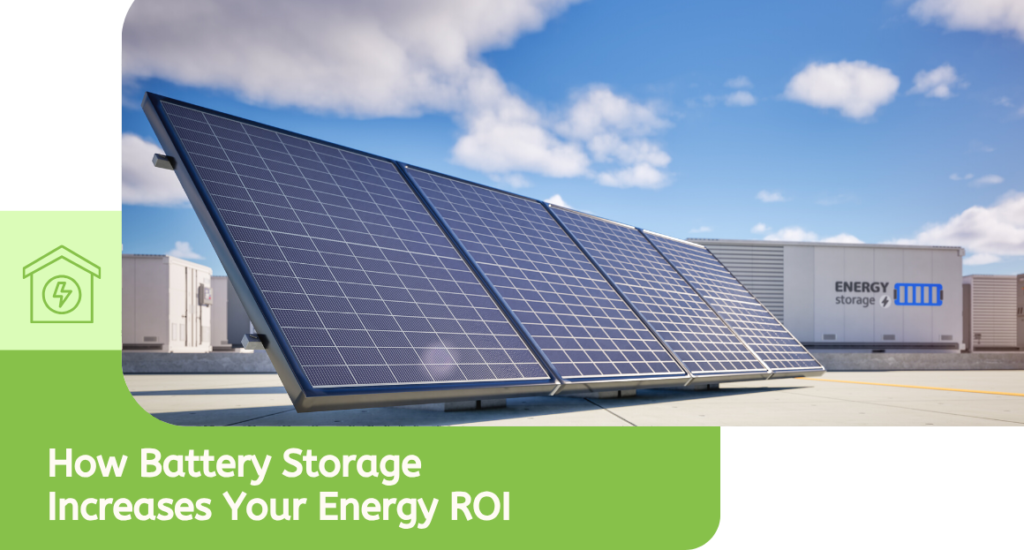
There’s always a bit of healthy scepticism when people hear phrases like “free energy.” Fair enough. Nothing in energy is ever truly free. But what battery storage does offer is something close to that: the ability to capture more of the solar power your system already produces and use it on your own terms. With the federal battery incentive in 2026 helping reduce upfront costs, more Australian households are getting closer to genuine energy independence.
Have rooftop solar? You’re generating your own electricity, reducing your grid reliance, and cutting daytime power costs. But solar alone doesn’t always deliver the full return they expected. Why? Because much of the power your system generates during the day is exported to the grid for a relatively low feed-in tariff, while you still buy electricity back at a much higher rate in the evening.
Battery storage can increase your energy ROI by helping you consume more of your own power instead of selling it cheaply and buying it back later.
With the federal battery incentive, solar panels with battery storage are available at a very low price. So, will adding a battery actually improve the return on my solar system? Yes, but only when the system is properly sized.
Why Solar Alone Doesn’t Always Maximise Your Return
Many Australians are out during the day. The house is quieter, appliances are running less, and energy demand tends to ramp up later, especially in the evening when everyone’s home, the lights are on, the air con or heating kicks in, dinner’s cooking, and devices are charging.
A lot of your daytime solar gets exported. Your panels might be doing their job beautifully, but the value of that exported electricity is often far lower than what you pay to import power later at night. In Victoria, that mismatch can make a solar-only setup feel less rewarding over time than it should.
This is why solar batteries for solar panels are becoming the next best step. Instead of exporting excess energy during the day, you can store it for later use. That could be for lighting, appliances, heating, cooling, or even EV charging in the evening.
Battery Storage & Energy ROI

Energy ROI is not just about how much you save upfront. It’s about how much value you can squeeze out of every kilowatt-hour your solar system produces over time.
Without a battery, the pattern is pretty familiar. Your system generates electricity during the day. You use some of it straight away, which is great. But if your home isn’t using much power at that moment, the rest gets exported to the grid. Then later in the evening, when demand goes up, you buy electricity back from the grid at a much higher rate.
With battery storage, that pattern changes in your favour.
Your solar system still generates electricity during the day, and you still use what you need in the moment. But instead of sending the excess away for a modest feed-in tariff, the battery stores it. Then, when the sun goes down and grid electricity becomes more expensive, your home can draw on that stored energy instead.
That improves ROI.
When homeowners install solar power with battery storage, they increase self-consumption, reduce their reliance on imported electricity, and get more real financial value from the solar energy they’re already producing. In plenty of cases, this is what turns a decent solar setup into a genuinely strong long-term household energy asset.
For Victorian households, this matters even more because feed-in tariffs are usually much lower than evening retail rates. Put simply, one stored kilowatt-hour is often worth more in your home than it is exported to the grid.
What Kind of Homes Benefit Most?
Battery storage isn’t equally valuable for every home, and that’s important to say upfront.
The best results usually come when the battery is matched to the way the household actually uses power. Homes that already have a solid rooftop solar system and tend to use more electricity after sunset often see the greatest improvement in ROI. That includes households running heating or cooling in the evening, family homes with steady night-time energy demand, and homes already exporting a fair amount of unused daytime solar.
It can also be a smart move for homeowners thinking ahead. If you’re planning for EV charging, switching to more electric appliances, or moving toward an all-electric household, a battery can become even more relevant over time.
This is why household solar batteries are increasingly appealing to homeowners who already have solar but feel like there’s still untapped value in the system.
Take a common example: a household that’s empty during the day and busy in the evening. That home is often exporting a lot of cheap solar power while no one’s there to use it. Adding a battery can shift that excess into genuine evening savings. On the other hand, a lower-usage household with minimal nighttime demand may not see the same return, especially if the battery is oversized.
That’s why, with residential solar batteries, the best ROI doesn’t come from installing the biggest battery on the market. It comes from right-sizing the system for the home in front of you.
What ROI Can Victorians Realistically Expect?
For a well-matched system in Victoria, a simple payback period often lands somewhere around seven to ten years. Homes with strong evening usage, an existing solar setup, and a properly sized battery may perform better, sometimes closer to six to eight years. On the flip side, homes with lower nighttime demand or poor system design may take longer.
A battery is not just another product bolted onto the wall. It’s part of a broader household energy strategy. When you install solar panels with battery storage, you’re not only looking at bill reduction. You’re also improving energy control, increasing resilience, and making the most of the solar system you’ve already paid for.
That’s why many homeowners now see solar battery backup as part of the ROI conversation. Even when the pure financial payback is moderate, the added value of backup protection, energy independence, and smarter solar usage can still make the investment worthwhile.
The Role of the Federal Battery Incentive in 2026
In 2026, the federal battery incentive has changed the conversation in a big way.
For many Australian homeowners, it has reduced the upfront cost barrier that used to make batteries feel like a “maybe later” upgrade. With lower entry costs, the return on investment is now far more practical than it was just a few years ago.
For eligible homes, the incentive can significantly reduce the cost of installing a battery alongside new or existing rooftop solar. That means a home solar battery system that once felt out of reach may now be far more financially realistic.
That said, it’s still important to keep expectations grounded.
A rebate can absolutely improve the numbers, but it doesn’t automatically guarantee fast payback. The real return still depends on how much excess solar your home produces, how much energy you use after dark, how well the battery is sized, what tariff structure you’re on, and whether you place value on blackout protection as well as pure bill savings.
Backup Power Is Part of ROI Too
One of the most overlooked parts of battery ROI is resilience.
A lot of homeowners focus only on savings, which is fair enough. But the ability to keep critical appliances running during a power outage has real value, too.
For households that rely on refrigeration, internet connectivity, medical equipment, or simply want a bit more peace of mind during disruptions, home battery backup can be a meaningful advantage. In an increasingly electrified home, that matters more than ever.
Not every battery includes full backup capability by default, and not every system is configured the same way. But when it’s designed properly, solar battery backup can keep essential loads running and add a layer of practical value that goes well beyond energy arbitrage.
As more Australians adopt electric heating, cooling, induction cooking, EV charging, and home office setups, the value of reliable backup power grows.
Understanding Home Solar Battery Cost
When homeowners search for the cost of a home solar battery, they often focus on the sticker price first. That’s understandable, but it’s not the best way to assess value.
The better question isn’t simply “How much does the battery cost?” The better question is, “how much more value will this battery help me capture from the solar system I already have?”
A battery should be assessed in context. That means looking at the upfront cost after available incentives, the usable capacity, the warranty period, and the expected throughput over time. It also means considering whether the system includes backup capability, whether it’s compatible with your existing inverter and solar setup, and how much annual savings on your bill it’s realistically likely to deliver.
It’s also worth thinking ahead. If you’re planning future EV charging or broader all-electric upgrades, that can change the value equation too.
This is where solar power with battery storage becomes more than just an add-on. It becomes a strategic investment. In some cases, a battery that costs a little more upfront but is better matched to your home may outperform a cheaper system that’s oversized, underused, or poorly integrated.
The Smartest Way to Increase Energy ROI

Battery storage increases energy ROI by helping homeowners keep more of the value they already generate.
Victorian households that add a battery see lower evening grid reliance, better protection against rising energy prices, energy independence, and, in the right setup, a more efficient long-term return on your solar investment.
So it’s time you start looking seriously at residential solar batteries and home battery backup in 2026.
If you already have solar and want to increase the value it delivers, battery storage may be the upgrade that turns a solid energy investment into a stronger one. Call us now to get a quote and know more about the rebates.