
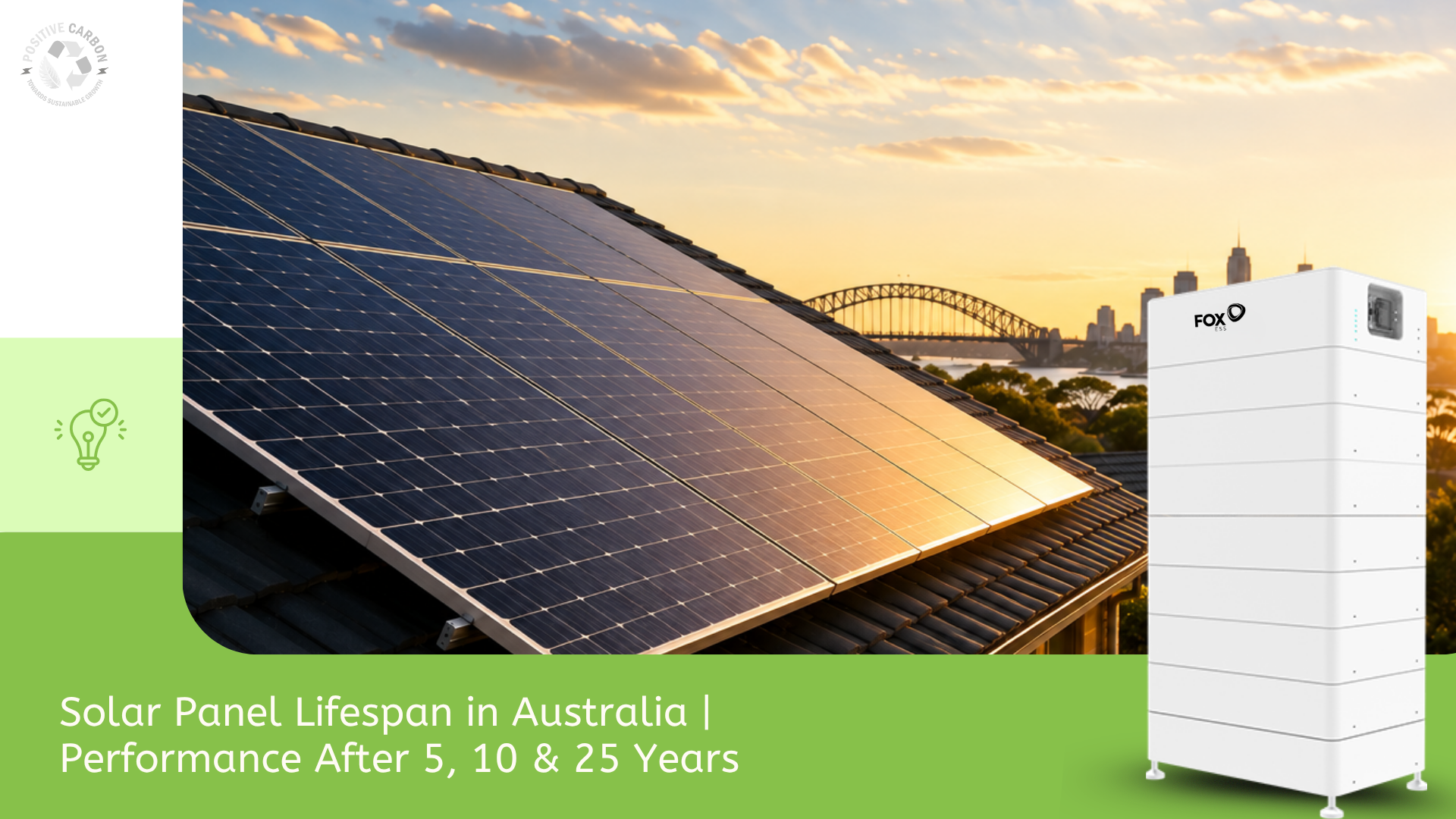
It’s one of the first questions almost every Australian homeowner asks before investing in solar:
“Will my solar panels still save me money in 10 years?”
“Do they stop working after 25 years?”
The short answer is reassuring: modern solar panels are typically designed to keep operating for 25–30 years or more. What surprises many people is that solar panels usually do not suddenly fail at the 25-year mark. Instead, they gradually produce a little less electricity each year, a process known as degradation.
Think of solar panels more like a car that slowly becomes less efficient over time while still doing its job.
For Australian households, this question matters even more. Panels installed on roofs across Victoria face strong UV exposure, summer heat, dust, heavy rain, hail, coastal salt air in some regions, and occasional storms. A system that performs well in these conditions can continue delivering valuable energy savings long after the initial installation has been paid off.
In this guide, we’ll look at what typically happens to solar panels after 5, 10, and 25 years, what affects their lifespan, and how placement, maintenance, and local climate can influence long-term performance.
The good news is that the first major milestone arrives much sooner than most homeowners expect, and it is usually far less dramatic than they imagine.
After 5 Years: The “Almost New” Stage
Five years after installation, most quality solar panels are still performing remarkably well. In many cases, panels retain around 97–99% of their original output, meaning the electricity savings they generate are often very similar to those achieved in the first year. At this stage, any performance concerns are more likely to be linked to dirt and debris, shading changes, or system components rather than the panels themselves.
One factor that continues to influence performance is roof placement in Australia; north-facing panels typically deliver the highest annual energy production, while east-facing systems capture more morning sunlight and west-facing systems produce more power later in the day when household energy use often increases. Although south-facing panels generally generate less electricity, they are still a practical option depending on the home’s roof design and energy needs. A well-positioned solar system can often outperform a larger system installed in a less favourable location.
Maintenance remains minimal during the first five years. Homeowners should conduct occasional visual inspections after storms, remove any leaves or debris that may accumulate on the roof, and regularly check their monitoring app for unexpected drops in energy production. These simple checks help ensure the system continues operating efficiently.
After 10 Years: The Mid-Life Performance Check
By the time a solar system reaches its tenth year, it has already delivered a decade of energy savings and weathered thousands of days of sun exposure. This is the stage where homeowners often begin to wonder whether the system is still performing as expected.
For most quality solar panels, the answer is yes. A well-installed system will typically continue operating at around 92–96% of its original output, although the exact figure depends on the panel brand, installation quality, and the conditions it has been exposed to over time.
In practical terms, electricity production may be slightly lower than it was when the system was new, but the reduction is usually gradual and often difficult to notice in day-to-day household use. Many Australian homeowners continue to see strong bill savings well beyond the ten-year mark.
Australian Climate Exposure Matters
One reason performance varies between homes is that Australian solar systems operate in very different environments. A rooftop in coastal Victoria does not age in the same way as one in rural Queensland.
- Coastal homes may experience increased exposure to salt-laden air, which can accelerate corrosion of metal components if they are not properly protected.
- Rural properties often deal with dust accumulation, which can reduce panel efficiency between cleaning cycles.
- Bushfire-prone regions may see smoke residue settle on panels after fire events, temporarily affecting performance until cleaned.
- Tropical areas in northern Australia expose systems to higher humidity and prolonged heat, placing greater stress on electrical components.
- Southern states generally experience less extreme heat, although lower winter sunlight and cloud cover can affect seasonal energy production.
These factors do not mean solar is unsuitable for any of these locations; they simply explain why long-term performance can differ from one household to another.
A ten-year service check is a good opportunity to assess not only the panels but the entire solar system. Key items include:
- Mounting hardware—check for corrosion, loose fasteners, or movement.
- Roof penetrations and flashing—ensure seals remain watertight and the roof has not been compromised.
- DC isolators and cabling—inspect for weathering, cracking, or signs of electrical deterioration.
- Inverter performance logs—review production history, error messages, and operating efficiency.
Catching small issues early can help prevent larger repairs later and maintain reliable system performance for the next decade.
After ten years, a solar system is best viewed not as an aging asset but as a mature energy investment. With routine inspections and timely maintenance, many systems continue to provide dependable electricity generation for another 15–20 years or more.
After 25 Years: The Warranty Ends, the Savings Often Continue
By the time a solar system reaches the 25-year mark, many homeowners assume it has reached the end of its useful life. In reality, the end of a solar panel’s performance warranty is not the same as the end of its ability to generate electricity.
Most quality solar panels are designed to continue producing power well beyond their warranty period. While output gradually declines over time, many systems still operate at approximately 80–88% of their original capacity after 25 years. That means your solar investment can continue delivering meaningful energy savings long after the warranty has expired.
For example, a 6.6 kW solar system installed today may still provide the equivalent of around 5.3–5.8 kW of output under similar conditions after 25 years. Although production is lower than when the system was new, it can still offset a significant portion of a household’s electricity consumption and help reduce reliance on grid power.
What Are Your Options After 25 Years?
Reaching the 25-year milestone does not automatically mean your solar panels need to be replaced. The best path forward depends on your home’s energy usage, the condition of your system, and your long-term energy goals.
Continue Operating an Efficient System
If your panels are still performing well and generating worthwhile savings, keeping the system in operation may be the most cost-effective choice. A professional system assessment can help determine whether your existing setup is continuing to deliver strong value.
Upgrade with Battery Storage
Many households that installed solar years ago did so without battery storage. Adding a battery can help capture more of the solar energy generated during the day and make it available during the evening, increasing self-consumption and reducing electricity purchased from the grid. For homeowners looking to improve energy independence, battery storage can be a practical next step.
Repower with Modern Solar Technology
Solar technology has advanced significantly over the past two decades. Newer panels can generate more electricity from the same roof space, offering higher efficiency and improved performance. If your existing system is approaching the end of its productive life, upgrading to a modern solar solution may unlock greater energy savings and support future additions such as battery storage or all-electric home upgrades.
Planning for the Next Stage of Your Solar Journey
The 25-year mark should not be viewed as a finish line. Instead, it is an opportunity to assess how your energy needs have changed and whether your current system is still the best fit for your home. Whether that means continuing with your existing panels, adding battery storage, or upgrading to a new high-performance solar system, the right advice can help you maximise the value of your investment for years to come.

Thinking About Your Solar System’s Next 10–25 Years?
Whether your system is 5 years old or approaching the 25-year mark, getting the right advice can make a significant difference to long-term savings. At Positive Carbon, we help Victorian homeowners evaluate their current solar performance and plan the most cost-effective next step.
Our team can assist with:
- Solar system health checks for older installations
- Performance assessments to identify production losses
- Battery storage solutions for better evening energy use
- Solar system upgrades and replacements using modern high-efficiency panels
- Guidance on available Victorian energy rebates and incentive programs
- Professional installation and support from consultation through to commissioning
Every home is different. Roof orientation, shading, electricity usage patterns, and future plans such as electric vehicles or all-electric appliances all influence the best solution. We take the time to assess your property and recommend an option that suits your energy goals and budget.
Book a Free Solar Assessment
If you’d like to know how much electricity your current system could still produce, whether a battery is worth considering, or what an upgrade might look like, contact us for a free assessment. We’ll help you make an informed decision about the next stage of your solar journey.
FAQs